



Versatility Offers Solutions
At McGill hose & Coupling we have an array of options for assembling the three basic components of any hose assembly. These are the hose itself, the end fitting, and last but not least the attachment method. The oldest hose assemblies had very basic and rudimentary attachment methods such as tight wire, and very basic clamps. As you can imagine these hoses were prone to failure and could only support limited pressures before end fittings were ejected from the hose. Fast forward to today, we have many different options for the hose, the fittings and the attachment method. All of which must work together to make a safe hose assembly. Over 50 years assembling hoses has taught us that there is no one way to assemble safe and reliable hoses. Our current attachment arsenal includes clamps ranging from simple worm drive for low pressure field installation to specialized clamps requiring tooling that produces consistent permanent results. On some of the biggest hoses and flexible ducting clamps are just about the only viable installation method and they perform their job well.
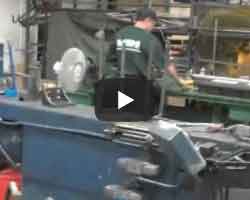
There are many ways of attaching hose fittings to hoses, but in the majority of cases crimping is the most reliable. In house we have crimping equipment which allows us to make Hydraulic hoses, Industrial Hoses, PTFE and Composite hose assemblies safely and reliably and in large consistent batches. We have highly trained team members and industry leading equipment allowing us to cover the wide range of needs our customers have. Few can match the large crimping diameters that we offer for industrial hoses that we can assemble.
Crimper pictures here:
Why Crimp?
Crimping is safe, consistent, and permanent. Unlike clamps that can loosen over time or be inconsistent in their gripping force and position crimping allows for repeatable specified installation. Crimping applies even force around the circumference of the hose over a large surface area. The crimp collar or ferrule are permanently compressed evenly onto the hose fitting applying greater force over a much larger surface area than conventional clamping methods. Crimp ferrules also allow interlock options that generally aren’t available with clamped connections and can make the hoses much safer for users.
Hose Barb and crimp ferrule pictures
Crimpnology – The Joining of Fitting and Ferrule
This component system is designed by one of our premier fitting partners Campbell Fitting. Instead of offering their version of a fitting and expecting suppliers to use generic crimp sleeves, Campbell developed a safe system that interlocks ferrules that are matched to their fittings. These ferrules bite or grab onto a specially designed interlock to retain the fitting even under the most severe circumstances. Hose assemblies generally have 3 components, the hose, the fitting, and the attachment method, Campbell has added one more. Their interlock allows the crimp ferrule to grab the end fitting whatever it may be around its specially designed interlock ring. This attachment method makes end fitting ejection under pressurization much less likely than with clamped hoses, or those crimped with sleeves. A clamp or a sleeve presses on the hose toward the barb of the fitting, but they don’t mechanically interlock with the end fitting like the Crimpnology fittings and ferrules do.